
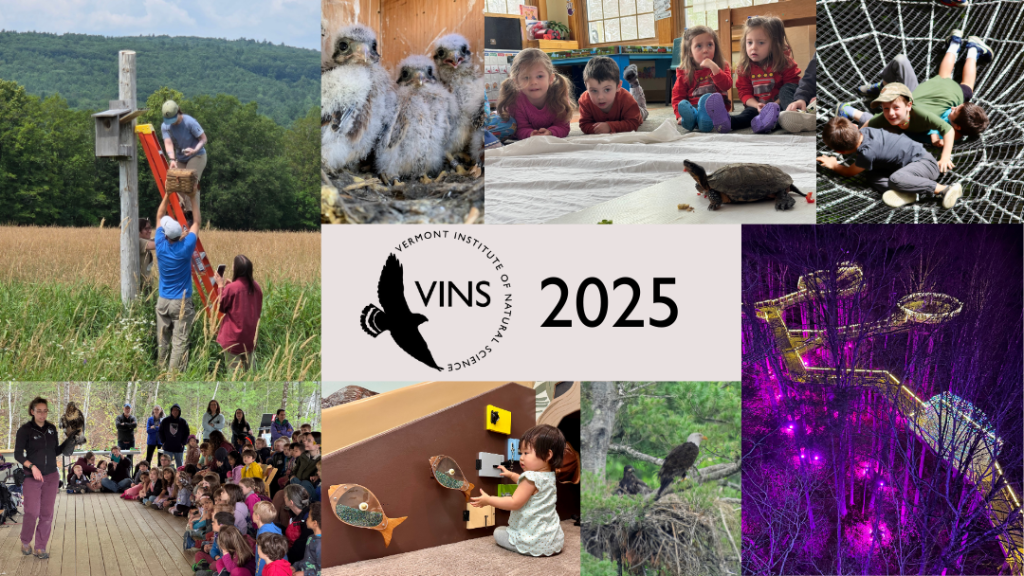
QUECHEE, VT – The Vermont Institute of Natural Science (VINS) is proud to announce an exceptional year of conservation achievements, wildlife rehabilitation, and public engagement in 2025.
The VINS Nature Center welcomed 84,068 visitors in 2025, connecting thousands of people with the natural world through live raptor exhibits, interactive programs, and educational experiences that inspire conservation action. VINS opened three new exhibits in 2025. The first was opened in spring 2025: The Beaver Lodge for Young Explorers, which invites children ages 3 and under to discover Vermont’s most influential ecosystem engineers through interactive play featuring climbing structures, tunnels, and sensory activities. The second was a temporary exhibit opened in summer 2025: a spotting scope from the top of the tower on the Forest Canopy Walk that offered guests the unique opportunity to see a wild Bald Eagle nest, home to a mated pair of wild Bald Eagles and their fledgling. And finally, a summer exhibit in collaboration with the Bernice A. Racy School in Hanover, NH: a Troll Quest, created by the talented “Kinderguardians of the Forest.”
During the holiday season, VINS hosted a record-breaking 13,194 visitors to the annual exhibit A Forest of Lights. This year’s exhibit included exciting new elements, and was supported by 12 corporate sponsors, all local Upper Valley businesses.
Across the Upper Valley, VINS School Programs brought vital environmental education into 43 schools, reaching approximately 2,400 preschool and elementary-aged students. These programs are enhanced by on-site programming at the Nature Center that deepens students’ understanding of the natural world, including 3,914 students who came to the Nature Center for field trips in 2025 and 427 students, teachers and parents joined for a 3-day Science Symposium in May.
VINS also welcomed 734 campers at VINS Nature Camp, with both summer and winter opportunities to explore the diversity of nature’s living creatures and habitats.
VINS Nature Camp nurtures each child’s curiosity and helps them to build respectful, caring relationships with themselves, others, and the natural world.
VINS Center for Wild Bird Rehabilitation (CWBR) treated 1,204 injured and orphaned birds in 2025, releasing 483 birds back to the wild for a 43.3% release rate. Although we typically treat large numbers of Barred Owls, they claimed the top spot among admitted species for the first time, with 111 individuals treated—surpassing the typically dominant American Robin (107). Other commonly treated species included Eastern Phoebe (55), Broad-winged Hawk (54), and Rock Dove (46). Among the year’s most remarkable patients were several unusual visitors: a Purple Gallinule, a Blackpoll Warbler, and a Rough-legged Hawk—species rarely seen in rehabilitation settings. CWBR will also soon be publishing a preliminary study in the Journal of Avian Medicine and Surgery evaluating a diagnostic test called the erythrocyte sedimentation rate with a method specialized for birds and small patients, with promising results for infection screening. Work is continuing along with collaborators to expand upon this initial study and adapt this test for more regular use in wildlife rehabilitation.
VINS Center for Field Research advanced multiple conservation initiatives in 2025. In its fifth year of American Kestrel monitoring, the team fledged young from 14 of 19 nest boxes and banded 68 nestlings. A new anticoagulant rodenticide screening program detected measurable levels in 10 birds out of the 54 nestlings and two adults that were sampled.
The research team was also able to capture and band 20 Broad-winged Hawks as part of our blood parasite monitoring project through our Center for Wild Bird Rehabilitation. Nine birds were sampled with measurable levels of rodenticides found in five birds. The eighth year of Monarch butterfly monitoring saw a rebound with 23 tagged individuals, up from 2024’s low of seven total captures. The second year of Northern Saw-whet Owl banding yielded 78 new bands and four foreign recaptures over 80 hours across 19 October nights. This included the station’s first recapture when an early October bird was found in Rhode Island three weeks later.
The VINS winter raptor trapping season in Addison County is currently underway. In the last half of the 24/25 winter season (January – March 2025) researchers captured and banded 16 Red-tailed Hawks, 1 Rough-legged Hawk, 3 American Kestrels, and 1 Cooper’s Hawk. In the first half of the winter 25/26 season (November – December 2025) researchers banded 5 Red-tailed Hawks and 1 Rough-legged Hawk. All five Red-tailed Hawks in that period were negative for anticoagulant rodenticides. Finally, in 2025 the research team conducted weekly water quality monitoring at two Ottauquechee River sites from May through August and confirmed all samples met Vermont recreational swimming standards.
“I’m proud of the VINS staff and volunteers for broadening and deepening our impact in 2025. And I’m grateful to our members and other visitors for continuing to show up and spread the word. The natural world needs an informed and inspired public, as never before. Our success in 2025 gives us great momentum going into 2026, a year of strategic planning for the future,” says Executive Director, Alden Smith.
The VINS Staff and Board look forward to another year of learning and growth in 2026.